Palfinger Epsilon: Pressure signal based sequence control for crane outriggers
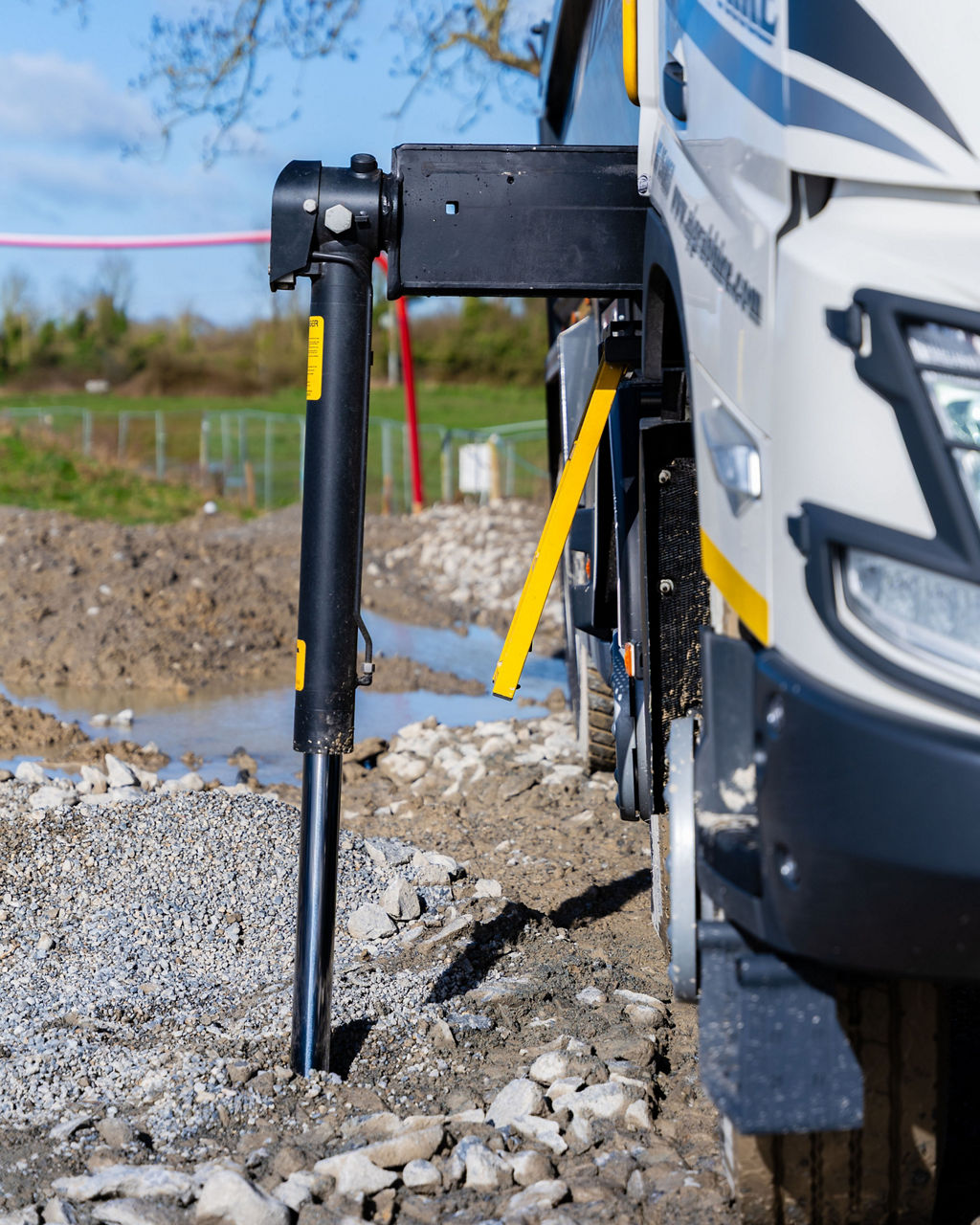
Palfinger Epsilon presents an outrigger control concept that detects, confirms, and automatically executes each step of the outrigger process in the correct order based on characteristic hydraulic pressure signals. The goal is a robust, repeatable workflow with minimal additional sensing. This publication relates exclusively to outrigger functions with horizontal outrigger beams (slide or telescopic) and vertical support legs; movements of the working boom are not part of this description.
The outrigger process is executed as a defined operation composed of a sequence of specific sub‑steps. Typically, the horizontal outrigger beams extend to their mechanical stops, the support legs are then lowered to ground contact, a preload is built up to unload the vehicle, and the chassis is optionally leveled within a defined inclination window. For parking, the sequence runs in reverse. At least one predefined pressure signal property is assigned to each sub‑step. A sub‑step is only deemed complete once its assigned signal property has been detected and confirmed; only then is the next step started. Exactly one sub‑step is active at any given time.
Detection is based on evaluating the hydraulic pressure involved in the outrigger operation. Pressure signals are captured centrally, for example at the pump or main supply pressure on the manifold, and/or decentrally at actuators. The controller determines pressure signal properties with a predefined time duration and continuously compares them with a stored set of predefined properties. These properties include exceeding a preset pressure threshold for a short minimum duration (greater than 0 seconds and less than 2 seconds), the rate of change of pressure (dp/dt) as an indicator of events such as ground contact, and characteristic plateaus or saturation behavior that indicate a mechanical end stop or the attainment of a preload. Thresholds can be defined as absolute values or as fractions of a configured maximum pressure. When a pressure signal property is identified, the controller assigns it to the current sub‑step, confirms completion, and continues the sequence. A dedicated pressure measurement of the actuator currently in motion is not strictly required, provided the system‑wide pressure signature can be unambiguously attributed to the active sub‑step.
Implementation is realized in an electronic control unit with state‑machine‑based sequence logic. Parameterizable time windows, tolerances, and digital filtering ensure stable detection under varying conditions, for example with different outrigger geometries such as H‑, X‑, or swing‑out supports and with different hydraulic concepts such as load‑sensing or constant‑pressure systems. During operation, protective functions such as pressure limits, per‑step timeouts, and plausibility checks are considered; manual operation can be selected at any time if needed. Events and detected pressure signal properties are recorded to support service, diagnostics, and validation.
A practical example illustrates the concept. When extending a horizontal outrigger beam, the system pressure rises briefly above a preset limit upon reaching the mechanical stop and holds this level within a short time window. This signature confirms the end stop and completes the step. When lowering a support leg, a characteristic pressure increase followed by a plateau indicates ground contact. During preload build‑up, a defined pressure level within a tolerance band, maintained for a short minimum duration, signals that the target preload has been reached. For the automatic parking sequence, the order is inverted; for instance, the full retraction of a support leg is confirmed by the typical pressure plateau at the upper end stop.
This publication is deliberately limited to outrigger functions. Terms such as “boom” refer here to horizontal outrigger beams and not to the crane’s working boom. Movements such as slewing, lifting, knuckling, or telescoping of the working boom are not covered.
Status: Technology pre‑release at concept stage. Details on parameters, interfaces, and variants will be provided as productization progresses.
Contact: Palfinger Epsilon Kran GmbH
Notice: This publication documents a product idea of Palfinger Epsilon Kran GmbH and establishes prior art for the described pressure‑signal‑based sequence control of crane outriggers. Implementation details may vary by application.