Being Better Starts in The Details
In the North Sea, storm, high seas: Every maintenance job on an offshore wind turbine farm is a race against the clock – the team has less than 20 minutes to move from one turbine to the next. In a winter forest covered in deep snow, 15 degrees below zero: logs are being loaded. Around the clock, seven days a week. Different worlds, same pressure. For the people who work here and for the machines they use. Only solutions that are technically brilliant can survive here. Solutions that were envisaged, designed and manufactured for these tough conditions from the ground up. Solutions that are engineered for Lifetime Excellence and make work easier for customers over the long term. This is precisely what PALFINGER stands for.
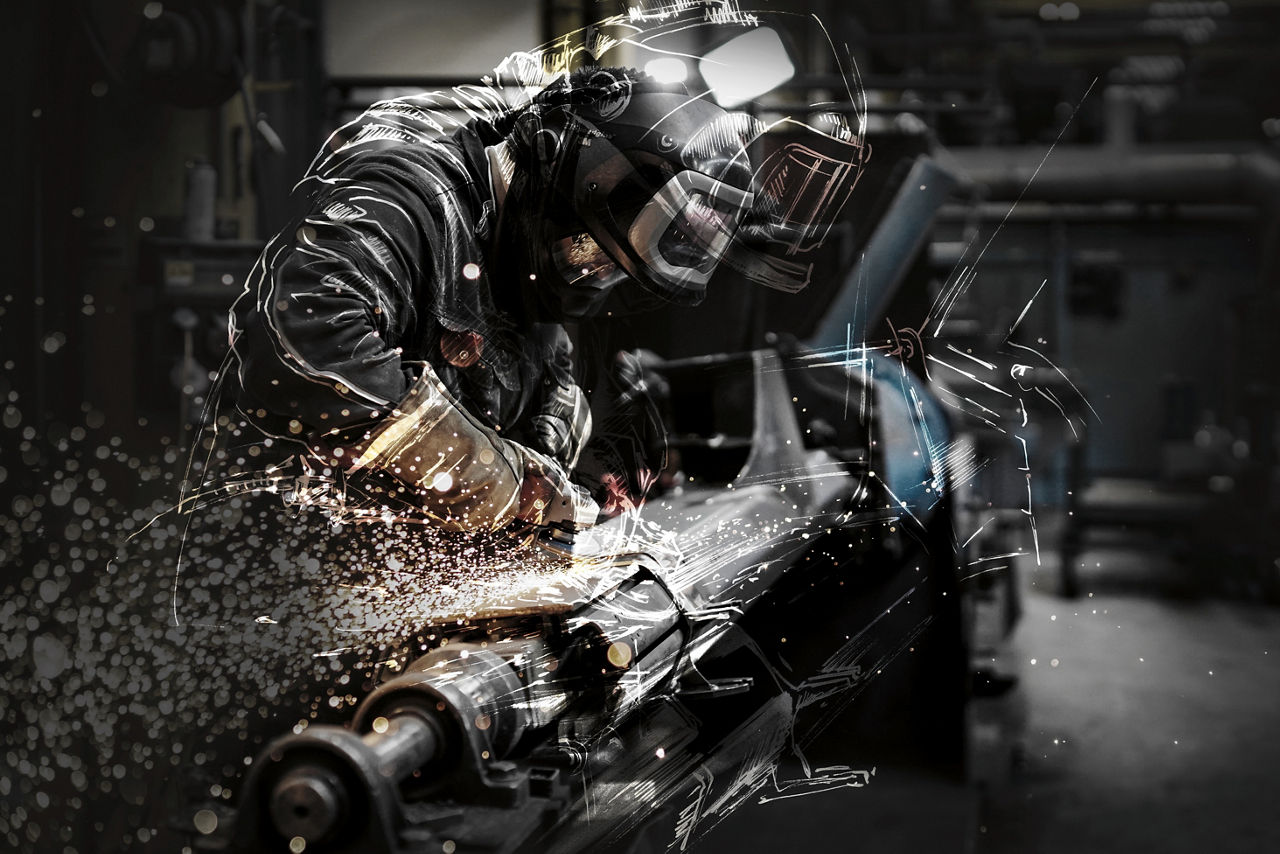
It is a magical moment. The moment when the voltage between the wire electrode and the workpiece becomes so high that the shielding gas between turns conductive and unleashes a dazzling-bright hot arc full of energy. The base material melts, as does the wire. A new connection is created. One that holds for the lifetime of the product.
On a small scale, the weld represents what makes PALFINGER stand out on a large scale: Lifetime Excellence. From ingenious design to precise manufacturing. From the initial contact with the customer to service over the full lifecycle of the machine. With smart technology that makes machines more powerful, applications more efficient, and processes safer. With the objective of delivering the highest quality and being even better every day. And with acomplete understanding of what really helps customers move forward. For innovations that make their work easier over the long term. For solutions that deliver what they promise. Day after day. For the lifetime of the product. In all conditions.
Tested Down to the Finest Detail and Smartly Manufactured
This is why the quality of each weld is carefully examined long before a product is used in wintery forests or on the high seas. With the naked eye as well as with ultrasound and x-ray tests. “Which testing technology is used depends on the type of weld, its location, and how easy it is to access,” explains Fahimeh Naghashi, Quality Manager at PALFINGER. Destructive methods such as macro testing are also used. This involves cutting a slice from the workpiece and etching it with acid in the laboratory to reveal the microstructure of the weld.
Technology is also playing an increasingly important role in making the weld. “Today, welding processes are heavily digitalized, even during manual welding,” says Juan Carlos Kraihammer. He is an expert at the PALFINGER Competence Center for Welding Technology in Salzburg and knows the details better than hardly anyone else. Modern welding power sources measure and regulate parameters like voltage, current, and wire feed in real time. This is how precise droplet transfer in the arc is ensured. The welder and the machine work as a team: “The welding robot does the meters while the welder is already preparing the next work step.” Together they create quality that lasts.
“Quality is not the responsibility of one individual. It is teamwork and embedded in every step of the process,” says Quality Manager Naghashi. The foundation for Lifetime Excellence is laid early on. At the pre-manufacturing stage, where parts are cut by laser and weld edges are precisely prepared. “It actually starts during product development,” says Kraihammer. PALFINGER in-house standards call this design for manufacturing. From the very beginning, the products are designed to be manufactured efficiently: quickly, precisely and to a very high level of quality. In operation, they do exactly what they should for customers: solve every challenge confidently.
"Quality is not the responsibility of one individual. It is teamwork and embedded in every step of the process."
Fahimeh Naghashi
Quality Manager Marine at PALFINGER

A Tough Test In The Forest
“Forestry cranes even operate in the dead of winter,” says Juan Carlos Kraihammer. That is often when the logs are frozen to the ground. The crane needs to pull, pull, and pull again. Until the log suddenly breaks free. “That is when the boom of the crane jerks upwards. Huge forces act on the crane, which has to withstand them.” It’s demanding work for the operator too, with long hours of precision handling in tough weather conditions and under constant time pressure.
To make work easier and safer for them, certain forestry cranes will in future be equipped with an autonomous solution for loading logs. The operator no longer needs to define crane positions during the loading process because now technology does that. The operator monitors the work steps. This takes a lot of pressure off the operator, enhances safety, and significantly shortens loading times. Especially in adverse weather conditions such as heavy rain, wind, changing visibility, or even in the coldest winter weather. A clear advantage for forestry companies.
On that subject, safety is PALFINGER’s top priority, also during training. The PALFINGER virtual reality-based training simulator enables crane operators to practice absolutely risk-free in realistic working conditions. The advantages are clear, because there is no machine wear, low operating costs, no risk of accidents, and training can be carried out regardless of the weather or location. A new version is coming out in 2026, that is even more compact, even easier to use, and even closer to real operating conditions. That is an example of “Being better” in action, every day. With the focus on the customer.
Sindre Halvorsen is also responsible for developing a solution that makes everyday life easier for the crane operator and gives customers a competitive advantage. In Bergen, Norway, 1,200 miles away from Salzburg, he works as a Mechanical Engineer on new marine products in the Cranes Technical Department.

"Huge forces act on the crane, which has to withstand them."
Juan Carlos Kraihammer
Senior Expert Welding Technology at PALFINGER

An Aerial Work Platform on the High Seas
Sindre Halvorsen is currently working on a genuine world first: an aerial work platform that balances automatically for use on the high seas. It has been engineered to make the maintenance of offshore wind farms significantly easier and safer for customers. For PALFINGER, it is one of the most complex development projects at the moment.
Wind farms on the high seas operate around the clock. Their maintenance is carried out from ships in strictly coordinated shifts. The change from turbine to turbine must not take longer than 20 minutes: little time for transfer and docking. Efficiency is what counts. No matter what the conditions are like. And in the North Sea they are often rough. Very rough. With high waves, strong winds, salty spray and cold temperatures.
The maintenance crew needs to be able to work as easily and safely as possible. At the same time, the maintenance contractor wants to minimize the time spent working on each turbine. PALFINGER has been developing the Offshore Passenger Transfer System (OPTS) to meet exactly these customer needs.
This system is the first of its kind that enables people to be lifted many meters upwards from a ship on a kind of hybrid aerial work platform and turntable ladder so that they can work safely, unaffected by the movements of the sea below. “We are applying our knowledge from aerial work platform development to do this,” says Halvorsen about transferring knowledge across product lines. Except, of course, working on the high sea demands special requirements, because it sometimes goes up, sideways and diagonally at the same time.
The unique feature of the OPTS is that it simultaneously compensates for these different movements at four different points. This is made possible by highly complex software. In fractions of a second, sensors record and analyze all ship movements and anticipate what happens next so they can immediately compensate. “When the ship rides upwards, the system lowers the basket to keep it stable,” says Halvorsen.
"For the Offshore Passenger Transfer System, we share and combine our knowledge worldwide. "
Sindre Halvorsen
Mechanical Engineer at PALFINGER

A Shared Goal
The OPTS connects knowledge from all over the PALFINGER organization: marine know-how from Norway, product development from Austria and aerial work platform expertise from Germany. Employees from Italy have contributed specialist knowledge to the development of the basket. Teams in Sweden and Poland have been working on the software. “We share and combine our knowledge worldwide,” says Sindre Halvorsen. This is how series production is possible within such a short timeframe.
It requires teamwork. A passion for technology. The drive to be a bit better every day. And last but not least, those magical moments of the arc when perfect welds are created from heat, precision and experience. Made for extreme applications. Made to meet the highest demands. Made for Lifetime Excellence.
Lifting Customer Value
Developing seamless, integrated solutions that are based on customer needs and create added value.
This is what PALFINGER understands as Lifting Customer Value.
With its strategic programs Technology and Market Leader and Quality Leader, PALFINGER is consciously setting priorities and driving them forward with precision: Innovations such as OPTS increase added value and bring customer productivity to a new level. The targeted expansion of the Marine business is part of the strategic direction Balanced Profitable Growth, which incorporates many unique solutions and is an example of successfully implementing market and customer-focused innovations.
