Home Sitemap      Language      Jobs     Extranet  Palfinger Websites
History:   KTL Special Search:  
KTL Special: Innovative surface coating technology for increased quality and environmental compatibility
 
> Why is PALFINGER investing in KTL?

The answer is simple: To make our customers and partners around the world more successful! 

Highest quality has always been guiding principal at PALFINGER. Ultra-modern production facilities, a high degree of automation and the use of high-grade materials and supplies guarantee an extremely cost-efficient production process and the quality for which PALFINGER cranes are renowned worldwide. With the installation of cathotic dip-coating units at the Marburg and Lengau production plants PALFINGER is creating a quality standard in crane manufacture which previously was only known in the auto industry. Customers benefit from a long service life and an appearance which are unique for hydraulic lifting, loading and handling systems.
> What does KTL mean?

KTL is the German abbreviation for cathothic dip painting. With this system, which represents the latest state of the art in paintwork technology, we are setting a further milestone in the quality and service life of our products.   

The KTL process has been used successfully for a number of years now in the auto industry and is leading to longer and longer warranty periods as far as corrosion damage is concerned. KTL is being deployed by PALFINGER as a new development in the sector for painting all crane components as well as for all other product groups. In contrast to conventional spray priming and painting, in KTL painting the coat of paint is applied evenly over the entire surface. The process also ensures that the primer coating without exception also gets into the cavities which cannot be reached in a normal treatment process. The result: Optimal corrosion protection for all components. 
> How does KTL function?

The elaborate surface paintwork is applied in 16 steps.

In this process the individual pre-treatment steps already ensure 90% of the quality before the actual paintwork is applied.

By blasting the metal with wire shot, an extremely aggressive blasting medium, the layers of scale present on hot-rolled sheet and plate and the impurities caused by welding are completely removed.

The parts are then degreased in two baths, rinsed twice and evenly activated. This is followed by zinc phosphating – a galvanising method similar to that used in the auto industry.

After two further rinses the surfaces are then passivated and the parts are rinsed once again, with ultra-clean water in a quality of below 20 μS/cm.


Not until all of these steps have been completed can the electrostatic KTL coating process take place, in which the part is completely immersed in the paint. It becomes the negative pole, while the immersion bath is positively charged by means of anodes. This makes it possible to achieve an even coating thickness and at the same time ensures that the paint reaches every single point on the part – a comparison could be drawn here with cavity sealing. The coating thickness can be adjusted in the range of ± 1 – 2 μ. Excess paint is washed off in two further work steps in an ultra-filtration bath; then the paint is baked on in an oven at a temperature of 115o C for 1½ hours. At this comparatively low temperature – the auto industry applies a temperature of approx. 160o C – temperature-sensitive parts can also be coated without any problem.


After transport to the second level there are two options for further-processing. Components which only had to be coated are transported down to the pre-assembly area. Parts such as the base frame, crane column and boom system are additionally painted in a further work step with water-soluble, environmentally friendly two-component paints by means of a spray robot. The robot system is programmed to handle all components and to recognise size and shape by means of the chip assigned in each case. Depending on the part, this process can take up to six hours. Only two people work in this unit. Four more people are required on the handling side, for hanging up and removing the parts.


If you would like to see a brief film extract on cataphoretic dip painting please click here:
Broadband/ADSL | Modem/ISDN

Or download here our KTL brochure as a PDF file.
> How corrosion-resistant are KTL-coated parts compared with conventional spray-painting?

PALFINGER uses a special KTL material from DUPONT which exhibits excellent properties also as a single-coat material. Wolfgang Pilz, who is responsible for the development of these facilities at PALFINGER: “The primers normally used are divided into two systems which entail various advantages and disadvantages. Epoxy primers offer e.g. excellent corrosion protection, but are not resistant to outdoor weathering.

Over the course of time the coating deteriorates as a result of exposure to UV light. Acrylic primers display a high resistance to weathering but provide less protection against corrosion. The material specially developed for us is different. Even applied as just a single coat, if we only use KTL material in a coating thickness of 30 μ without any additional topcoat, it meets the requirements of a 700-hour salt-spray test. This involves a precisely specified testing procedure: The painted part is damaged by a precisely defined cut through the paint down to the base material. The salt spray test is then conducted. Next, the corrosion creep is measured at the cut, and we must not exceed a maximum value of 1 mm creep. This results in the specified 700 hours. If a topcoat is additionally applied we reach 1,000 hours and over in the test.”


                                           KTL                                                                             No KTL


> On which PALFINGER products is KTL currently being used?

PALFINGER Knuckle boom cranes               RAILWAY Railway applications


PALGATE Tale lifts                                       ACCESS Aerial work platforms
More info                                                      More info


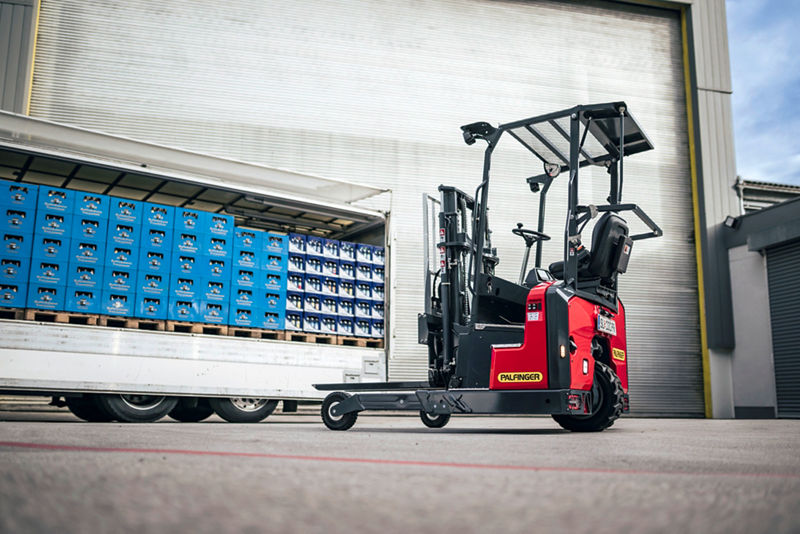
CRAYLER Transportable forklifts                 EPSILON Timber and recycling cranes
More info                                                       More info

  
 > KTL: Environmental protection is all important

The exhaust air from the ovens and the painting booth as well as from the evaporation zones merely reaches a level of 6,000 m³. This exhaust air is treated in a thermal combustion process and the heat is recycled.

Wolfgang Pilz: “We use it to heat the lower and upper oven. Any heat left over is supplied to the heating and hot water system for the PALFINGER plant at Lengau. The baths too are included in an automatic regeneration process. The dirty water is treated in a vacuum distillation process and recycled. As a result, the system functions completely without any waste water. There are no toxic substances anywhere in the process.”
 
> The PALFINGER Anti-Aging Program

The strategy of PALFINGER is based on three pillars: Innovation, Internationalisation and Diversification.

By "Innovation" we understand the result of our passion for the permanent improvement of product, process and organisation.

With KTL a significant, innovative and for the sector pioneering step has been taken into the future. A step which holds great promise of success for PALFINGER customers and which guarantees every product user a clear competitive advantage. Again and again, every day! Because KTL makes the competition look particularly old now, and this will be even more noticeable in a few years’ time...

For more information on the KTL campaign send an email to: marketing@palfinger.com
  
Print